
Part one of the
Stranded chronicle series.
Balac woke with a scream boiling in his lungs and the world on fire. The heat of it bit into his skin, raw and feral, and the sudden, molten pain turned his vision white. The smell of burning flesh choked the air inside the dropship cabin. Balac had been in the field since the beginning. He had, as Krin was fond of saying, “seen some shit.” Images of Krin’s smiling face being torn apart by a plasma round. He stared at the inch of air that now separated his lower leg from the rest of his body. Yeah, some shit, he thought, numbly. The flesh on his upper thigh bubbled softly. It was a clean cut. No blood. Whatever had chewed through his leg had cauterized the wound instantly. Already the nanites in his bloodstream were converging on the trauma site, and as they worked, the pain subsided to a steady thrum.
Balac sat mesmerized by the severed limb sprawled in front of him. For a mad moment, it seemed that he could just reach out and put it back on, slip it on as easily as an old shoe. The click-whir of movement snapped him alert. He looked up. The drone looked down. For a long moment they stared at one another before, slowly, its front limbs detached from the roof of the dropship and its segmented body arched downwards. It hung there, waiting, dangling in a way that seemed idly threatening, possibly curious, and then with stop-stutter grace pulled itself up and out of the hole it had made in the dropship’s roof, the skitter-scratch of its movement echoing in the empty cabin below. Seconds later, a viridian beam sliced through the hull, paring apart a section of metal that clanged to the floor no more than a few feet from where Balac sat. His thigh twitched, in fear or recognition he didn’t know, but Balac was already moving. Kicking and cursing, he dragged himself over the edge, grunting as he dropped the last few feet to the ground.
Outside, cords of smoke twisted into a broken sky. Balac watched as, in the distance, dark shapes swam through a haze of smoke and settling dust. Hundreds of them trawled back and forth across the wide, arid bowl. Skitter drones were among the first wave of Reclaimers sent in after the fighting died down. Cutting, grinding, and tearing, they reduced anything left on the battlefield into manageable waste, ready to be collected by the swarms of Harvesters that followed in their wake. With single-minded focus, they erased the battlefield, making sure nothing of value went to waste. Behind him, Balac could hear the drone going busily about its work. In a few hours, he thought, it would be as though the battle had never happened. As though they had not fought and died and bled here. It was then that the gnawing unease that had been growing inside him burst into realization. The battle was over! And yet for some reason he was still here.
He ran two fingers across his forearm and the embedded display reacted instantly, conjuring a shimmering topographic map of the area. In any given battle, the map would be overlaid with dozens of blinking bio signatures pinpointing the location of his fire team and any enemies within scanning range. Now, it was empty. Balac blinked. He was alone.
Hotswaps were common in areas of the galaxy where the fighting was particularly intense. There was seldom time to pack everything up. Far more efficient to redeploy on the frontlines and let the Reclaimers do the cleaning up. Somebody in operations would hit the kill switch and every clone keyed with the proper ident would drop dead where they stood. Seconds later they would wake up on the other side of the planet or half a galaxy away – the exact location seldom mattered anymore - ready to fight. This time Balac never made it.
He drew his sidearm. A Minmatar-designed weapon, the weight of it felt good in his hand. Familiar. Like a warm breeze on the Matar plains. Like the smell of wild Rikmal at dawn. It felt like home. He wondered idly if he would ever see it again.
“Your body is worthless,” said a long ago voice.
“Equipment can be replaced. Your knowledge is what’s important. Your experience is what matters. Whatever happens, you get back into the fight by any means necessary.”
“Standard operating procedure,” Balac finished for the voice, lifting the weapon to his temple. The metal felt cool against his skin. There was no-one around. No CRUs and no waystations that he knew of. And definitely no MCC. If he died, would he even wake up in his clone body? Probably. Maybe. He couldn’t be sure. His hand trembled slightly. On his worst nights, he had prayed for death. The true death. To join Kali and The Hundred as they rode across the Sky Road for all eternity. His finger tightened on the trigger.
I need your help, Traveler.
It was as if someone had breathed the words into his ear, and Balac almost blew his brains out from the sheer surprise of it. Instead, he jerked the weapon around and leveled it at the space where he expected to find the person who had somehow crept up on him. His sudden movement caught the drone’s attention. It twisted its torso in his direction, but detecting only Balac, chirped indignantly and resumed its methodical dissection of the dropship, prying it apart with the care of a mother and the precision of a surgeon. Balac almost fired on it out of spite.
You must listen.
This time, Balac felt the voice more than he heard it. Felt it in the knit of his augmented bones, in the slow turn of his genetics. He wondered absently if this was what insanity felt like.
He tried to stand then, but overbalanced and landed on his freshly amputated limb. Pain clawed up his spine and his pulse slammed in his ears.Instinctively, he grabbed at the wound, which only made the pain worse.
You are here for a reason. There is something you must see.
Through gritted teeth, he grunted, “Sorry, but I’m a little busy right now. Maybe another time.”
You must head south. There’s something you need to see.
“Yeah, you said that already.”
The voice pressed on. It must be you, Traveler. Only you. You must come quickly.
Balac glanced down at his stump. “Sure, I’ll get right on that.”
And then the voice was gone and Balac felt silence seep back into the world, the kind of thick quiet that comes from exhaustion. From a world that, in the aftermath of such sudden explosive violence, had grown numb. He pushed himself upright and went back to studying the map. One way or another, he decided, he was getting off this planet. But it quickly became obvious that the map was hopelessly out of date. His suit’s built-in sensors were severely limited, and the last global refresh – each fire team was supported by a networked TACNET augmented by ground- and air-based surveillance units - had been hours before. If he'd had any doubt he was alone, the absence of reliable telemetry was proof enough.
He picked and prodded his way across the virtual terrain for what seemed an interminably long time and was about to shut off the map to conserve energy when he saw it. A communications outpost five hundred clicks from his current position. Radio for help. As plans went, this was pretty straightforward, but he didn’t have much else going for him just then. It was his best shot. The biggest problem was getting there. He didn’t much like the idea of dragging himself across five hundred kilometers of rocky terrain on his stomach. He started crawling anyway.
It didn’t take long to find what he was looking for: a C12-KLK sniper rifle. It leaned against a blood-soaked rock, as if it had been waiting for him all along. The Kaalakiota-manufactured weapon was a favorite among mercs. Using microscale railgun technology, it effectively weaponized velocity, placing an otherwise inert round accurately downrange in excess of 2,500m/s. It could easily penetrate two-inch-thick depleted uranium plating from over a thousand meters. It would also make a fine crutch. Using the rock for purchase, Balac pulled himself to his feet and tucked the upended rifle under his arm.
Finding transport proved a good deal harder. What hadn’t been wrecked beyond repair had already been pulled apart. All around him, white-hot sparks flashed in the quickly settling dark. The Reclaimers were nothing if not efficient. He stood there for a moment, unsure of where to go.
Balac tried to make sense of the rock and sand and shadow. In the dying light, it all looked the same to him. The wind had started to pick up, and flecks of sand stung his face. He couldn’t imagine the sort of weather that had hewn the ragged, awkward columns... And then he saw it, a shape that was less than the ghost of a memory. He turned toward it, moving with more certainty than he felt. He picked his way up a short slope of loose gravel. It was hard going, but in the hours since he first set out, he’d become quite adept at using the upturned rifle to pick his way across the shale and loose rock of this world. He crested the small peak and saw it just as it had been in his mind’s eye.
His heart leapt in his chest at the sight of the smooth-curved Light Attack Vehicle, exactly where he had left it. And then fell to his feet as he saw the familiar shapes of Skitter drones moving towards it. He counted two. Without hesitation he dropped to the ground, ignoring the pain that fleeced up his half-limb, tucked the rifle neatly into the crook of his arm, and fired. The lead drone crumpled in a heap, and even as it did the second was turning and heading for the slope and Balac. Reclaimers were not designed to fight. But they were programmed to protect themselves and their salvage, and as Balac knew all too well, they were more than capable of doing that.
The Skitter drone moved quickly across the uneven terrain, closing the distance with alarming speed, its long legs a blur of motion. Balac fired and missed as the drone cut between an overhang, the round pulverizing the shale outcropping just as the drone disappeared behind it. He adjusted his aim, tracked just ahead of its zig-zagging path, exhaled, and fired again. This time the round tore through the drone’s torso, which shattered, pieces twitching horribly, in some unfelt caricature of pain. Then he heard a familiar noise and realized his mistake.
The skitter-scratch sound reached his ears an instant before the third drone – the one he never saw - mounted the ridge and reared up, pincers stabbing and tearing at the air in front of it. Balac dropped the rifle, simultaneously pulling his nova knife, and with practiced skill slammed the blade up and in, the white-hot edge activating on contact, cutting into the soft underbelly, the buckled metal tearing at his flesh as he buried his hand into the drone’s abdomen. Blood, his own, poured from the drone’s wound. It practically shone against the brushed metal luster of the drone. The momentum of the strike carried him forward but, without a leg to steady himself with, fell over, teeth gritted tight as he collapsed on top of the drone. It flailed frantically beneath him, one of its limbs catching and tearing open his armor, gouging a deep red line along his side. In response, Balac leaned heavily on the knife, driving it in up to his elbow. The heat of pain and then, after, the warmth of blood flowed along his arm. The drone’s twitching grew slower and then stopped altogether. When he was certain it was dead, Balac pushed off it and rolled onto his back, breathing heavily and grasping for his rifle.
Working quickly in case more Reclaimers showed up, Balac pulled a corpse free from the driver’s seat, got in, touched his hand lightly to the dash – the vehicle’s onboard systems synced immediately with his suit – stalled, cursed his missing leg, restarted the engine and peeled out, the tires spinning then gripping as the four-wheel-drive Methana accelerated out of the loose gravel. Balac didn’t look at the corpse as his high beams flashed across it, pale features defined briefly and then gone, swallowed in the black of night. He didn’t need to. He already knew the dead body was his own.
He hadn’t been driving long when the voice spoke again. You said you would come immediately. You lied. Balac thought it sounded genuinely hurt.
“I promised nothing. Look, I’m sorry. I can’t help you. I’m getting off this planet. Tonight.”
You will not find what you seek.
“Well, then I guess one way or another one of us will get what they want tonight.”
Balac didn’t.
The communications outpost was nothing but a crater, a half-kilometer-wide wound of rock and metal. Billions of ISK obliterated. Balac could only guess at what happened. For all their greed, for all their talk of bottom lines, the corporations were a spiteful breed. Whoever lost this location must’ve decided that if they couldn’t have it, then no one else would either. Or maybe it was a warning. Whatever the reason, it no longer mattered.
“You win.” He said, knowing the voice was listening. “Tell me where to go.”
Balac drove through the night in silence. Perhaps sensing his mood, the voice spoke only when it needed to.
Follow the river bed east 40 kilometers. Continue due south for 10 kilometers.
And so it went until, just as the light of a freshly cracked day seeped in over the horizon, the voice simply said, Here.
It looked no different to Balac than any of the sparse dryland he had traveled across over the course of the last six hours. He wondered, not for the first time that night, just how insane he really was.
Now dig.
“I have a better idea,” he said and fished around in the vehicle’s stow crate. He came up smiling, his hands filled with Tri-nine explosive.
“Hope there’s nothing fragile down there,” he said to no one in particular, and started digging. After he had dug a small hole, placed the shaped charge, refilled the hole, and retreated behind the cover of the LAV, Balac pressed the remote trigger.
The earth sighed, a deep sucking in of air, and then bellowed as it spat a tower of dirt into the sky. Balac felt an odd sense of petty satisfaction as clods of soil rained down.
When the smoke and dirt and dust cleared, Balac lowered himself down into the hole, which was far larger and deeper than he had anticipated. He had, he guessed, tapped into an underground cave of some kind. He coughed, choked on the millions of dust motes that clung to the stale air, and wished he had thought to bring a light. As his eyes grew accustomed to the dark, he noticed the thin outline of a shape, an obsidian surface discernible only by how much darker it was than the black around it. Balac had almost walked into it before he realized it was there. He ran a hand across its ice-cold surface, which, despite being directly underneath the blast, didn’t appear to have a scratch on it. He was still marveling at how impossibly smooth the surface was when an opening appeared and the voice spoke.
Welcome home, Traveler.

Part two of the
Stranded chronicle series.
I should have stayed down.
A long ago thought. An unwelcome memory worn thin by time. I shake my head and the memory drifts loose. I let it go.
Every story has a beginning, says the voice. But yours, Traveler, is a story of beginnings.
“What the hell is that supposed to mean?” is what I want to say, but can’t seem to think of the words. This bothers me, I think, but the thought disappears before it can fully form. Around me, the darkness shifts restlessly. It seems impossibly tight, the air too thick. Thoughts slip by unnoticed. I want. I want... my brain scrambles for something, anything to latch onto. The memory floats up out of the darkness, like a bloated corpse bobbing to the surface. And this time, like a drowning man, my mind grabs on and doesn’t let go.
I can taste my blood. Can feel the grinding murmur of station machinery beneath me. The metal is cold against my skin. I need to get to my feet. My head feels impossibly heavy. I try to move, but every cell in my body screams in protest. Their laughter chases echoes around the corridor. They’re lost in the moment. High on victory and adrenaline and whatever else is coursing through their veins. It won’t last long though and when it does they will end me. Get up! Get up! Get up! I lift my head in time to see him turn and start running toward me. The moment comes on slowly, moving with the singular inevitability of an iceberg.
He doesn’t expect me to move. Not with the injuries they’ve given me. So when he kicks out, I grab his ankle and twist. He yelps, I suspect from surprise more than anything else, and then again, this time in pain, as he comes down hard on his hip. I’m up and moving then. The pain is a demon harpist, plucking at nerves that sing in agony. I reach the first of them, a tattooed Civire, just as he raises his weapon. I reach up and grab his wrist, punch him in the throat, and yank down hard. The weapon falls loose and bounces out of reach. Shit. But he goes down, choking. The other two have to move around him, which buys me just enough time to throw up a loose guard. I ride the first wave of blows – fire erupts across my chest - and kick out hard, hoping for a shin. I feel bone shift, something gives and then he’s down and screaming, clutching his knee. I turn, too slow, and a punch snaps my head back.
The world flashes black then white. Too bright. I squint and duck instinctively at a shadow, a swing that glances off my shoulder. I move for position, almost slip on something – spit or blood maybe, I wonder absently if it’s mine – but somehow manage to get in close enough to lock up an arm. Our eyes meet for a second and I see understanding there. I smile through bloody teeth, then jerk his arm straight and bring as much weight down on it as I can muster. His elbow shatters, the sick sound of it swallowed by his screams. To his credit, he doesn’t go down. He staggers back, cradling his arm. When he turns and runs, I almost chase after him in spite of my wounds.
The capsuleer is back on his feet. I wonder how long he’s been watching. He is tall and lean and his skin impossibly smooth, except for a designer scar along his jaw. What he does next unnerves me more than any threat or slur ever could. He starts to laugh. The same free, unburdened laughter I first heard back in the bar.
I don’t want to be here. Not in this station. Not in this bar. And not chasing ghosts. At first, the raucous laughter is grating, but before long I’m listening intently to what’s being said. What was it Tanvalin used to say? The truth of the world can be found at the bottom of a glass. Even from a booth half-way across the room, I can hear the man’s drunken boasts.
“It was a suicide mission and I knew it. But the payout was too good. No way was I going to let someone else have a crack at it.”
“Fucking capsuleers,” mutters a man too young to look that old. “Think they’re so special.” He raises his glass and then drops it back down, cursing me under his breath when I don’t reciprocate. I’m in no mood to talk. I’m more interested in listening to the conversation that I and most of the bar are being subjected to.
“And your crew?”
“You know,” he says, lowering his voice to a conspiratorial whisper. “I’d completely forgotten about them.”
Laughter.
“So you jettisoned your pod and left them to die?”
“And what kind of man would I be if I did that! Of course not! I went down with my ship like any proper captain should.”
At that the table erupts in laughter.
I’m surprised to find myself pushing my way through the crowd even before he’s finished talking. I wonder if this is the sort of person Tanvalin worked for. Was it a quick death? No, I don’t believe that. That’s not how the world works. Tanvalin suffered. He dared to dream of a better life. Was arrogant enough to believe that hard work and determination would get him out. And for his hubris he suffered. When the ship’s shields failed, and the armor was gone. When all that was left was a wafer-thin hull, naked and exposed, did he panic? Or did he trust in the skill and judgment of a single person to save them all? A capsuleer into whose hands he and the rest of the crew had placed their lives. A capsuleer like this one. Tanvalin always trusted people.
Like most, I know little about capsuleers beyond the stories and rumors. But I know they bleed.
“You were a fool, Tan.” I mutter to myself, and charge the capsuleer. He stops laughing then.
He is trained, but not well. He is slow and predictable. I brush aside a few half-hearted strikes, break a hold, and smash my forehead down into his face. It hurts so badly that for a second I think I might pass out, but the satisfaction of feeling bones break keeps me going. He throws a few jabs, short, tight motions, catches me in the ribs with one that makes me wheeze. I feel something wet in my lungs and the taste of fresh blood in my mouth. He steps in and follows up with a knee, but rage and grief have long since carried me over the edge and I barely register the hit. I tackle him to the ground. He says something then, but I’m already punching and barely hear it.
I imagine Tanvalin in those final moments. I want to think of him helping others to lifeboats, screaming orders or sealing a breach, working defiantly to the last. But all I can see is my brother’s face twisted in pain and fear as round after round tears through the ship’s hull, venting metal and bone and blood into space, wondering if the next strike will be the one that finally takes him. A faraway klaxon screams in my ears, hollow and keening. Tears sting my eyes. I can barely see the capsuleer but every punch comes away sticky with blood. I don’t know how long it goes on for, but when I open my eyes his face is pulp, and my knuckles raw. It’s only then that I hear the klaxon’s ringing for what it really is: the sound of my own screams bouncing off the metal walls.
The memory fades and for a single moment my senses are my own. I’m back in the darkness when I hear the voice again.
You have come a long way, Traveler. But your journey is only beginning.
And then the darkness swells once more, like the hitched breath of a great beast. I feel it rise up, pouring into my mouth and lungs, feel the pressure behind my eyes and the sick sensation that I’m being crushed from within.
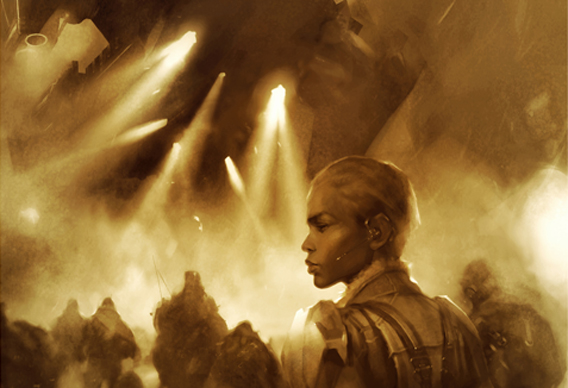
Sitting in the transport, staring at the stony faces around me, wondering what lies ahead, I can’t help but think that I should have stayed down. Maybe things would have been different then. Maybe I’d be with Tanvalin again. Maybe one day. The restraints cut into my ankles and wrists. In the end the choice had been a simple one: prison or the Valklears. That was how I found myself enlisted in the most elite fighting force the Minmatar Republic had ever produced. That was how I found my life’s calling. And all I had to do was kill a man.
Part three of the
Stranded chronicle series.
They call us “Kilm'ach.” The Lost. We are the demons of their Scriptures.The Beast made real. We scare them, and they hate us for it. Or perhaps we simply remind them too much of the past. Of the heritage they’ve forsaken and the people they betrayed. More likely, though, the Ammatar who live here hate us because we came to take their planet.
Whatever the map says, New Eden ends at the borders of the great empire. Outside of the hisec systems, civilization does not exist. Not the way most people would like to believe anyway. Out here, you see the true face of humanity. And it is the face of madness.
By the time I arrive on Khabi VIII, a fringe planet in a highly contested corridor bordering Ammatar space, I have been in the Valklears for seven years. I’ve paid for my training in scars and nightmares. The past is a glove-skinned awareness, barely felt. Old memories numbed by the fresh pain of new wounds. These days, I find the pain comforting, a convenient distraction. It might not be peace, but it’s a good enough substitute.
We’re moving slowly, stepping across a carpet of bodies. Tanvalin ghosts through my head. This is what you do now? Kill civilians. Through a series of small, interconnected rooms – scattered equipment, more dead scientists – labs by the look of it, and into a long, empty corridor: the perfect place to get shot. I motion for Neera to stay close, and together we crouch-run to the end of the corridor. We’re halfway there when the door at the far end slides open. Neither of us misses a step. There’s nowhere to go but forward, straight into whatever’s waiting for us on the other side.
Inside, the rib-vault is twice as high as it is wide. Dirty light spills in through aging windows, filling the room with a sick, yellow glow. Cracks trace elaborate patterns across filigreed sections of the walls and floor, wrap around a statue, like decrepit fingers searching for something to strangle. Blood-red rust feeds on the faded gold surfaces. There is nothing quite as depressing as Amarrian architecture.
We move forward, glass shards from the shattered work terminals crunch under foot.
“It’s beautiful,” gasps Neera, either ignoring or having not seen the bodies, one of which is slumped at my feet, just inside the door. This must be what triggered it to open. Poor bastard.
“It’s a dead end. We should keep moving.”
But Neera’s not listening. She’s lost in whatever place she goes to. The same empty look on her face from a few nights before as we sat outside enjoying the cool night air.
“What are we doing here?” she asks. A light breeze tugs at her hair, dragging a rebellious strand across her harsh-boned face. Large, gray eyes stare through me, like distant stars shining in an ebony sky.
From my puzzled look, she asks, “Here. On this planet. Why are we fighting?”
I want to tell her that we have no choice, that we’re just following orders. But the truth is that I don’t care why we’re fighting. And I don’t want to stop. Because stopping means having to think. I say nothing.
“Of all people, the Minmatar should understand the importance of freedom. We should know better. But here we are. At the end of the day we’re just like everyone else. We take what we want and damn anyone that stands in our way.”
“I don’t think—“ I start to say.
“No! We’re worse than everyone else!” A flicker in her eyes. Rage maybe, or yearning. It’s all I see in her eyes lately. “At least the Amarr have something to believe in. They work for the future, while the past defines everything we do. We use it to justify our actions. But we’ll never be better than we are now, because we’ll always be chained to what we once were.”
“I want nothing to do with the past,” I say, and mean it. “But what the Republic is doing is important. What we’re doing is important. And as long as we keep doing it, the Republic will be free,” I lie, wanting to make it better, to fix whatever’s broken inside of her, and knowing that whatever I do, whatever I say, it’s not enough.
She looks away from me then. “You’re wrong. We’ll never be free.”
“We’ve got nothing, Sarge.” Squawks my headset, snapping me back to the present and a room full of bodies.
“Alright.” I reply. “We’ll finish up here and meet you in twenty.”
“You’re the boss.”
Shadows pool in the gaps between shafts of light. The darkness shifts, a twitch of alarm and the animal knowledge that something is watching. A wrong thing. Unseen, but felt on the edge of awareness. Watching. Waiting.
“C’mon. We still have two more floors to check out.”
Leaving, we both glance back, each of us looking for something we’ll never find.
It takes us hours to search the rest of the facility. We scour it room by room, but each one is the same. Dead bodies. No sign of the prototype. Occupation of the planet began months ago, and clearly, the fighting got here long before we did.
I’m almost ready to call it off when the dry cough of gunfire booms through the corridor.
“In here!”
Neera’s voice.
I kick into a sprint, but Lesik is through the door first. There’s another deep cough, and then a spray of gore blows back out into the passageway. Shredded tissue, long, wet strands of it, flies past my face and coats the wall opposite. Lesik, what’s left of him, is dead before he hits the ground. I step over him, weapon tucked into the crook of my arm. And what I see stops me cold.
Neera standing in the middle of the room. Daraket at her feet, wide-eyed, his hands tangled in his own viscera, the red of it gleaming brightly under the artificial lighting.
“I was hoping you’d be first through the door. I thought that if I didn’t see you, I could go through with it.”
Her words flush the adrenaline right out of me. My limbs suddenly feel very heavy. “Drop the gun, Neera.”
“I can make it better! I-I finally know what to do.”
“Drop the gun, Neera. Please.”
“Don’t you want to know why I did it?”
“The ‘why’ doesn’t matter. It’s what you do that matters, whatever the reason. And you just killed two men.”
“I freed them, chintaku.”
“Don’t call me that. Not anymore.”
She stiffens at that. Then drops the gun and spreads her arms at her sides, palms open. To the casual observer it might look like surrender, but I know what the gesture really means. Have seen it a hundred times in the sparring chamber where we practice. It’s a challenge. And I always accept.
Neera is all soft technique, always has been. But she catches me with a backfist strike to the side of the head that seems to surprise her as much as it does me. She smiles then and for a moment she’s the Neera of long ago. I smile back, in spite of myself. This is insane. Then draw my knife and drop into a combat stance. After that, things fall into a familiar rhythm. She moves like a liquid whirlwind. Punches slide off her as she slips in and around everything I throw her way. It looks effortless, but the sheen of fresh sweat betrays the concentration it requires.
The Sikan style she practices is all about redirection. Using the attacker’s force against him. But I’m giving her nothing to work with and the frustration is starting to show. She gets too eager and comes forward when she should be retreating. I catch her with a lateral chop that knocks her back, but even off-balance she falls into a leg sweep that catches me just above the ankle.I’m back on my feet in a single motion, blocking and countering with adrenaline speed. We could go on like this forever, a geometric blur of limbs locked together for the rest of our days. Some part of me wishes that we would. The rest of me wonders how I’m going to live without her. I make my decision and then wait for my chance.
When it comes, I see it in the tilt of her shoulders, the subtle shift of her stance. The memory of it wired into muscles through countless hours of practice. I telegraph the move, knowing she’ll see it and slide right by. Past my outstretched arm, hooking and then snapping my wrist, taking my weapon and then, while I’m off-balance, killing me with it.
The moment spreads out in front of me. I lunge forward.
Except this time she doesn’t move. The knife goes in easily. The cold knowledge of it shatters and pierces my heart. She pulls me close, a gasp escaping her lips as the knife slides deeper. I can feel the life beating out of her, warm and wet. She kisses me and I can taste her blood on my tongue.
“Thank you, chintaku.” My love.
She goes soft then, the weight of her sinking into my arms. I squeeze her tight, hoping that if I can just hold her close enough, that if I wait long enough, she’ll open her eyes again. That everyone will stand up and together we’ll walk outside, laughing and joking and everything will be like it was. As I wait, time falls away and I lose myself in grief.
The faint awareness of movement snaps me awake. Daraket’s corpse stares accusingly at me. You knew what she was. This is your fault. Neera is lying on my chest, her arms around me like so many good mornings before. Suddenly, her grip tightens, and I feel the muscles in her neck stiffen as her head lifts itself and fixes me with gray, dead eyes. And a voice that isn’t Neera’s speaks from a face that is no longer hers.
“Why do you try to forget? Memories, Traveler. They’re what make us who we are.”
The darkness swallows me.
Part four of the
Stranded chronicle series.
I hate space. Even the word is a misnomer. There’s nothing vast or open about it. Two years on board this ship and it’s still all I think about. I feel it pressing against the hull, cold and heavy. Hear it in the thousand creaks and moans of the Ingress as she pushes deeper into the smothering black.
The corridors on the way back to my compartment are empty, but elsewhere on the ship people are busily going about their work. There is no room for passengers on board a Thukker caravan. Everybody contributes. Outsiders, as I’ve come to learn, doubly so.
Fatigue hangs over me like a lead jacket. But even tired, I know when I’m being followed. I glance back. Nothing. During the downshift cycle the strip lighting in the corridors is turned low. Good for saving power, great for sneaking up on someone. I keep walking. The day Neera died - The day you killed her – I left. When I was done mourning, I stood up, walked outside and just kept going. I guess I always knew someone would come for me.
As I walk, the fatigue burns away, replaced with the savage anticipation of the fight to come. I round a corner, then immediately turn and step back into the corridor just in time to see a silky shadow disappear into the darkness of a small maintenance alcove. A shiver of familiarity crawls up my spine. Run. Something uneasy in the movement. Fear scratches at the back of my mind, frantic as a caged animal. Run. The shadow moves again, and this time the oil-slick motion triggers a star burst of understanding. The lab on Khabi VIII. The fight flushes out of me. RUN! I turn to run just as the heat of the explosion surrounds me. Scorching tongues of it licking my face and then gone, sucked out of the gaping hole in the corridor wall into the suffocating emptiness. And me along with it.
***
I wake in darkness. Gasping for air. Sucking in hungry mouthfuls that hammer spikes of pain through my brain. Lights spasm and arc across my vision. Dizzy. I reach out a hand to steady myself, but only succeed in falling over. I throw up. I lie there for a moment, floating in the center of my own spinning universe. Slowly, in the faraway galaxy of my mind, nebulous recognition forms. The spinning slows and confusion coalesces into anger.
“What the hell did you do?” I scream the words, but they wither in the darkness and barely reach my own ears. I try to stand, but the spinning starts again and so I lie back down. “That’s not how it happened!” I yell. Again, the darkness swallows the sound of my voice.
I feel numb. Every part of me heavy and slow, like being underwater. My mind slams into my skull as though it’s had enough of all this and wants out. I want to die. Instead, I focus on the ground. The ground is solid. The ground is real. Need to keep moving. But where? Forward, chintaku. People should always move forward. Even in my head, the sound of her voice is enough to make me cry. I start walking.
The darkness pushes against me. I lean into it. I’ve fought in heavy gravity before, but never felt anything like this. It tugs at my arms and leg. Clings to my ankle like a desperate lover. I walk for hours (Days? Minutes?), but each step feels no closer or farther than the first.
*
“Well, you would know, Traveler. They are your memories after all.”*
I bow my head into the invisible storm and press forward.
“You can’t outrun them you know. Not forever.”
The darkness rises. A wave of shimmering heat and pressure, the tide of it carries me back to the ship and the fire and the screams.
***
The corridor is just the way I remember it. Burning, but intact. Up ahead, a woman runs past, a cloak of flame billowing behind her. She doesn’t scream. As the fire swallows her, she simply hunches closer over the small bundle she’s carrying in her arms. I turn away from the sight. There are some things even I don’t want to see. Thukker caravans carry entire generations on board. Families live and die without ever leaving the ship. But most live longer than this.
An arm reaches out of a darkened doorway and pulls me inside. The door’s still sliding shut as I reach around and twist the wrist on my shoulder, and in one smooth motion pinion my attacker’s arm and slam him into the wall.
“Hey! No, wait!”
He tries to turn around, but I apply more pressure and he grunts in pain.
It’s me! Jet!”
Jita. Calls himself Jet. I remember now. Strong kid. Worked a couple shifts down in the Skews together. His parents named him after the system he was conceived in. Parents can do shitty things to their children sometimes.
I let go.
“What’s going on?”
He squeezes his shoulder. “You almost broke my arm!”
“You’ll live.” I say, knowing I’ve hurt his pride more than his arm.
“We’ve been boarded.” He says, finally. “I was running a diagnostic suite when the entire board lit up. They blew a hole into the maintenance bay on Deck 4.”
“What! Who?” I imagine Valklears storming through the corridors. If this is my fault... If I brought this on these people... I shut the thought down before it can go any further.
“Does it matter?”
“Yes!” I say a little too loudly. “Yes it does.”
“Well, sorry, but I didn’t stop to ask. Vartigin says he heard you were a soldier before. Is that true?”
I ignore the question. “How many of them?”
“I don’t know. Maybe ten?” Still rubbing his arm.
“For a ship this size? They’ll need a lot more. And I’m going to need a weapon.”
Jet walks across the room, does something with a panel that I can’t quite make out and comes back holding what might as well be a rock for all the good it’ll do me. A Gistii-10. Small, compact and horribly inaccurate at range.
“Where did you get that?”
He shrugs. “This isn’t the first time something like this has happened.”
“Stay here.” I say, and snatch the weapon from him before he can object.
***
I count sixteen. They’re armed and efficient - in ten minutes the entire sub-section is locked down - but they’re not Valklear. Dressed head-to-toe in black. No insignias or markings of any kind. Whoever they work for, they don’t like to advertise. Everything about them is low-key. Everything except the weapons they’re carrying. Shiny, hi-tech. I look at the aging Gistii in my hand. With no better option, I wait.
Eventually, they split up. I watch as the larger group disappears around the corner, give it a few minutes just to be sure and then, with a silent thanks to whichever miser son of a bitch insisted on the low lighting protocol, move round the corner in a bent-knee run, closing as much of the gap as I can.
Twelve meters out someone sees me, but three shots center-mass puts him down before the others even turn. I get one more shot off, tagging one of them in the ribs, before the shouting erupts and the shooting starts. The corridor boils with the hungry hiss of gunfire. A wild spray of shots. The sick sizzle of metal to my left. I ignore all of it, focus instead on the nearest target. The Gistii jerks in my hands. Once. Twice. And then he’s falling back, grabbing at the wall, collapsing. One of them is screaming into his headset, but as the others go down he pulls a rifle and rakes it across the corridor. The stutter-whine of impacts all around me, metal shards sting my face and arms. I blink something warm and wet from my eyes. Focus. I get the Gistii back on target and empty the clip. He jolts, staggers, still firing wildly, and then is down on the ground, bleeding over his friends.
If they didn’t know I was here before, they do now. Shit, the whole ship must have heard that. I need a new weapon. I need to find cover. I know what I should be doing, but instead I’m screaming into the face of the only raider I can find alive.
“Who sent you?”
“Damnit! I said tell me who se—“
Something slams into me from behind and a warm wetness blossoms across my chest. I sink to my knees.
A voice, from what seems far away, “How did this Thukker trash get in here? Fuck. Look at this mess.”
Lying on my back, looking up at the ceiling, the corridor seems suddenly very bright. “I won’t let you take me.” I try to say, but my tongue feels too thick for my mouth and it comes out like a groan.
The voice looks down at me, weapon still in hand. “There’s always one isn’t there? Way to go, hero.” Then he turns back to his men.
“C’mon. Get that container on board and let’s get the hell out of here. G’dammit! Be careful. He wants it undamaged.”
I watch them leave through the makeshift hole in the wall.
Out into the crushing dark.
Part five of the
Stranded chronicle series.
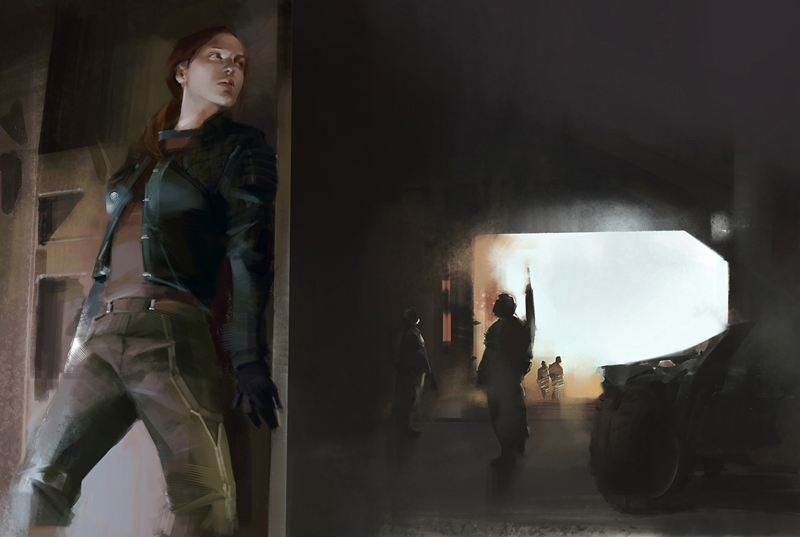
She found him in a small, sparsely furnished room in a quiet part of the station. She had gotten lost on the way down. Twice had to double-back down narrow passageways lined with doorways identical to the one she now stood outside. On the shuttle over, through the checkpoints and past the graffiti soaked walls, she had thought about what she would say and how she would say it. But now, standing here, listening to the rusty shunt of the door lock disengage she wasn’t so sure. She should leave. Go back home and pretend that none of this ever happened. But then the mechanism sighed and the doors pulled apart and there was nowhere to go but inside.
He was well-built with long hair that draped across sweat-slick olive skin pulled taut by the muscle underneath. Exactly as her informant had described. Well, almost. He hadn’t mentioned the wheelchair. It looked small and awkward beneath his large frame. She stared a little too long, but if he noticed her discomfort he didn’t say anything.
“Mr. Ansacre? Berlin Ansacre?”
He said nothing so she pressed on.
“My name is Adriel Ghislaine,” she said, just as she’d practiced.
“I’m a reporter with The Scope,” she continued, feeling only slightly guilty about the lie. “I understand you were on board the Thukker caravan that passed through here a few days ago. If you don’t mind, I’d like to ask you some questions.”
“I do mind. But we both know that’s not going to stop you.” His voice was like bottled thunder. Even in a wheelchair, he practically crackled with pent-up energy.
She tried to sound desperate, which wasn’t hard because by now she really was.
“I know the caravan was attacked. What I don’t know is by whom or why. I need to know what you saw.” She moved closer, touched him lightly on the arm. “Please, it’s important.”
Later, she would remember the look of cold purpose in his eyes. How he had grabbed her arm, and with a single firm tug, pulled her off her feet. His left arm a blur from somewhere behind, locking her in his lap and the feel of the blade pressed in tight against her neck. Right now though, all she felt was the insect swarm of panic buzzing through her head.
“Please. No.”
“Who sent you?” He hissed into her ear. “How did they find me?”
“No-one sent me. Please, oh, please... I’m sorry.”
“Who sent you!” The knife cut into her skin.
“No-one, I swear! I came alone. Please, no-one knows I’m here.”
She bit her mouth closed on the words but it was too late. No-one knows I’m here. She felt the knife start to move and she knew she was as good as dead. But then he did something she would never have guessed. He let her go. She crawled across the room, a table-top vidscreen flicking to life then fading as she scrabbled past and onto her feet.
“I believe you.”
“Oh, now you believe me?!” A cocktail of adrenaline and fear and anger rinsed through her voice. “You couldn’t have decided that before sticking a knife to my throat!”
“Because a minute ago you were lying. For a reporter, you’re not very good at it.”
Adriel felt her face flush red, but whether it was the anger or just embarrassment at being caught in a lie, she wasn’t sure. She was a reporter, after all, and it was only a matter of time until she would be working for The Scope. All she needed was one big story. This story.
Quiet seeped into the room, hung there for uncomfortable seconds.
“Still, I’m sorry. I should’ve known just by looking at you.”
“What’s that supposed to mean?” She said, momentarily forgetting the thin line of pain across her neck.
“It means I’ll tell you what I know. But, first, I want to hear what brought you all the way out here.”
She sighed, but it caught in her throat. Folded her arms over her chest, put them at her sides, folded them again. Eventually, she settled on the edge of a wide metal shelf, gripping it tightly to stop her hands from shaking. A coarse fabric was bundled at the far end. His bed, she guessed. But she didn’t care. It was as far from him as she could get and still be in the same room.
“Two months ago I was contacted by a man named Malon Shircore. He claimed to be a member of a research team working on a top secret program-“ she held up a hand “-yes, I didn’t believe it either, but then he started sending me proof. Bits and pieces mostly. Files and research notes, a lot of which I didn’t understand, but it was clear that his team was working on fullerene-based biological applications. Specifically, nanite-infused blood plasma. They even got as far as a first-generation prototype.
“Interesting, but not exactly news. Why contact you? He dissect one too many small animals and suddenly grow a conscience?”
Adriel managed a smile. “Something like that.”
“His team worked for a small subsidiary. They received specifications, raw materials and funding and then simply handed over whatever they had when the deadline was up. Sweatshop science at its finest.”
He nodded slowly, listening.
“The teams were kept small and isolated. No-one knew what the others were working on, but somehow Malon found out. And he didn’t like what he’d found. So much so that he contacted me.”
“A little far-fetched don’t you think? What could possibly have been important enough to risk his career, maybe even his life, by selling out company secrets?
“This.” She pulled a datapad from her jacket pocket, thumbed the biometric scanner and held it out to him.
“You’re going to have to get a little closer than that,” he said, gesturing at the wheelchair.
“Uh-uh. This time you come to me.” She spoke slowly, trying to keep the tremor out of her voice.
Adriel thought she saw him smile, a flicker of amusement gone as quickly as it appeared. He worked the arm panel and the wheelchair quietly closed the space between them, then he leaned forward and, never breaking eye contact, snatched the datapad from her.
He stared at the image for a long time. She watched as his brow furrowed, the muscles in his jaw tightened and relaxed, his eyes narrowed and then widened. As though his face couldn’t decide what emotion to express first.
“A corpse?” He shook his head. “Whatever it is, it’s not human,” he said at last, handing the datapad back to her.
“Not unless someone changed the mould,” she agreed.
“What the hell was your scientist working on?”
“That’s what I was hoping you could help me with. What did they take from that ship?”
He thought for a moment, then said, “I don’t know.” He sounded almost apologetic.
“Wait-what do you mean you don’t know? You fought the raiders. Apparently, the only person on board that did. Why would you do that if you weren’t trying to stop them? You had to have known something the others didn’t.”
“Sorry to disappoint you. But I don’t.”
“Unbelievable. You threaten me, almost kill me, and all you have to say is ‘I don’t know’. Thanks for nothing.” She got up to leave.
“They were professionals, that much I can tell you. They knew exactly what they wanted. An entire ship of cargo and all they took was a single crate. No bigger than a coffin-”
They stared at one another.
“You don’t think...” Adriel began, but she was already moving towards the door.
“I think your scientist friend has a lot of explaining to do.”
“He would,” she said. “If he wasn’t already dead.”
***
She got lost on her way back to the shuttle. She’d been so busy thinking about what Berlin had said that she hadn’t been paying attention to where she was going. And then she was so busy looking for a sign or a map or something to get her out of here that she didn’t notice the man until she almost walked right into him.
“Oh, sorry,” she said, and smiled meekly. It was a pretty smile. It had gotten her out of trouble many times before. And into it more times still, she thought sourly.
He smiled back. And then pulled a gun from his coat.
“You’ve been asking entirely the wrong kinds of questions.”
Two short coughs. And then he was gone and she was falling.
It hurt less than she'd imagined. Bullet wounds look painful on the dead, she supposed, precisely because the body was already cold. A moment's pain frozen and stretched into eternity. What must it be like, she thought, to have your life anew? Would it change anything, or would you still be the person you always were? Would you have given up when you had the chance?
Her fingers traced a path of blood, obscuring the datapad's screen. Dabs and streaks, all different shades of the same crimson. It was all here. Everything she had pieced together over the past weeks. She wondered if she should have told Berlin about the weapons. It didn’t matter. She hadn't figured it all out yet, there hadn't been enough time, and she realized just then that she never would. Still, the implications were clear. And the possibilities terrifying.
She clutched the datapad tightly. An anchor when every part of her wanted to drift away, dragged into oblivion by currents beyond her control. Alone in the darkness she cursed the scientist for finding her, for choosing her to confide in. Cursed him for being a coward. No. She was the coward. The one who was afraid of giving up, of admitting she was scared. The one who would follow a story to the bitter end, in this life or any other. Adriel Ghislaine, fearless reporter. The tears were warm on her face and the pain tore at her insides.
And then she was floating. The station's gravity control must be malfunctioning, she thought. The technicians would have it fixed in no time. And with that she closed her eyes and drifted into the darkness.
Part six of the
Stranded chronicle series.
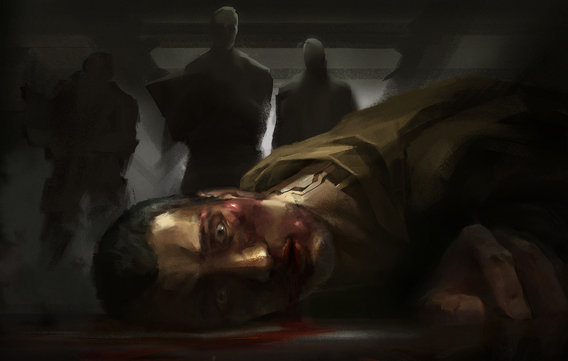
When they come for me, I am alone in my room picking through a madman’s conspiracy. Shipping manifests, eyewitness accounts, email correspondence, hacked security footage. All the information I’d copied from the reporter’s datapad. Data that at first seemed completely random had, in the days since, started to make a lot more sense. Like one of those children’s puzzles, an optical illusion hiding a picture within a picture, the longer I stared at it all, the clearer everything became. The noise faded and, slowly, a pattern took shape.
The room fills with light. The brightness is overwhelming. Backlit by the stark, narrow-banded lighting in the corridor, three large shadows step through the opening door. I rub at my eyes. A thick, oily tear greases my face. Darkness leaks into the room, a roiling mass of black tar that comes bubbling through the walls, the floor, the ceiling. The men don’t seem to notice it. They keep on coming.
I try to blink away the liquid, and my eyelids almost stick together. I wipe at my face and my fingers come away black. I feel the tar ooze from my nose. I start to cough, hocking up thick fists of it. The darkness continues to rise, drowning the room in the tallow black of a thousand midnights. And through it all, they keep coming. The light from the doorway shrinks to a pinprick, and then everything is gone and I’m surrounded by nothing. Not for the first time, I throw up.
“Do you remember now, Traveller?” The voice is soft and expectant, almost pleading.
Fighting back the nausea, the smothering heat of this place. “What are you talking about? I know all of this.”
“Knowing is not the same as remembering.” Disappointment in the voice now.
Why is it so hard to think? Fuck you, fuck this place. I want out. By way of response I pull my sidearm and fire into the dark. It barely makes a sound and I keep pulling the trigger long after I run out of bullets. Somehow, somewhere in the dark I hear the soft plink of metal. I move towards it.
“Did you give them up willingly or did they take them from you?”
After a few steps I reload, fire until I hear the sound again, re-orient myself, and keep moving.
“You must remember.” Anger.
A lance of pain stabs behind my eye. The nail-scrape sensation of something fingering my brain drops me to my knees and, slowly, the memory puts itself back together.
A rust-red wall appears first, followed by a table, squat and square, and then floor panels smeared a darker hue than the wall. Dried blood, something in me intuits. Pieces continue to fall into place and the room starts to take shape. But even before it comes together it’s clear that this is not my room. Armed guards stand at attention around me. They wear the red and black trim and blank stares of special forces.
After the room, the next thing I notice is how badly my jaw hurts. I touch it and pain erupts across my face. I remind myself not to do that again.
“Sorry about that. But you can be a little stubborn.”
A voice behind me. Its owner leans into view. He is brown-skinned, black of hair and eye, with tectonic features that crack and spread awkwardly as he smiles.
“Vantus Torin,” I say.
“General Vantus Torin,” he corrects.
“You’re a general now?”
“And you’re a cripple.” For a Krusual, Vantus is unabashedly direct. He never tip-toes around the truth, which is why I’ve always liked him.
He smiles. “Come, I have something to show you.”
Glaring at the guards, wondering which one of them hit me, I guide the chair out into the passage and pull up alongside him. The passageway leads out onto an enclosed overpass, transparent sections of which give a spectacular view of the intra-station terminus below. Trams come and go as we walk in silence. Mostly, I’m trying to figure out how to get out of this alive. It is Vantus who speaks first.
“After what happened on Khabi VIII we thought we’d lost you. Then I read the report of the attack on the Ingress and knew it had to be you. So I sent some men to look into it.”
I punch the panel and the chair slams to a halt. Vantus steps briskly to the side to avoid tripping over it. “You ordered the attack? You’re responsible for putting me in this?”
“Yes. And no. That”-he points at the wheelchair-“you did all by yourself. The men we hired were under strict orders not to do any unnecessary harm to the people on board that ship. But then you show up and damn near wipe out half their team. I’m surprised they didn’t kill you.”
I wish they had. Something shifts in the mountain of knowledge I’ve built up over the last few days, collapsing under the weight of a hundred facts, the clear surface of understanding exposed beneath. “You stole your own shipment.”
To his credit, Vantus doesn’t deny it. “In a way, yes. What we took belongs to all Minmatar. Not just those who believe they make decisions for all of us.” He hesitates for a moment, chooses his words carefully. “They want to hide it away. Study it. I want to use it.”
“And what is it, exactly?”
His dark eyes shine. “Our salvation.”
“The Republic needs an army, Berlin. Now more than ever. And with this we finally have the means to create one. An entire army of immortals. An unstoppable force.”
He leans on the armrests of my chair, his face inches from mine. In it I see the haunted stare of a people, an entire nation’s pain bubbling under the surface. I think of Neera. Eyes moist with suffering and hardship so intense that it is carried in the DNA of each generation. And I wonder why I don’t feel the same way.
“We can save all of Minmatar. Us. Not Skymother. Not the Elders and their empty prophecies. With this we can lift our faces from the mud and shit the rest of New Eden has cast us down into.”
I finger the knife hidden in the smooth side-mould of the chair. Everyone underestimates the handicapped. I could kill him right here. Or take him hostage. Use him to get a ship and get the hell out of here. A tram zooms overhead, the muted rumble of its passing shakes the entire overpass. And go where? I’m tired of having to look over my shoulder. I see Neera and all her dreams and hopes for our people. I let go of the knife.
“Immortal soldiers, huh?” I say finally.
Vantus pushes off and steps back. He seems visibly relieved.
“I thought it would take more to convince you.”
“I haven’t said yes yet,” I remind him. “If you have all of this”-I gesture around myself-“what do you need me for?”
“We can create an army, but we can’t manufacture experience. You’re a decorated soldier, one of the finest I’ve ever worked with.”
“Ex-soldier. Last I checked deserters got a bullet, not a medal.”
Vantus waves it away. “As far as I’m concerned, Berlin Ansacre is dead. You no longer exist. But what you’ve seen, what you know, what you remember, that will live on.”
“And,” he says it almost as an afterthought. “We can give you your legs back.”
Thinking back, that was the precise moment Berlin Ansacre died and Balac was born.
Part seven of the
Stranded chronicle series.
“It takes seventy-two hours,” a bored looking lab coat tells me, “for all cognitive, memory and motor functions to be mapped and routed through the neuro-interface socket implanted in your head.” The NIS is a fountain of metal spouting out my skull. Bulky and uncomfortable, the weight of it makes it difficult to keep my head up straight. “A temporary solution until the procedure is complete,” says the coat when I complain.
“And what happens when the procedure is complete?” I ask.
He gives me a look of practiced annoyance that says this will be less painful for both of us if I stop asking questions. I shut up and with a weary sigh he goes back to work.
It’s hours before I’m allowed to return to my quarters. I don’t see it until I’m almost on top of it. Lying in the middle of the floor is a gun, and underneath it, a handwritten note with just two words on it: KILL YOURSELF. I would learn, much later, that seven days is the maximum allotted time for a recruit to commit suicide and complete the procedure. Anyone who fails to do so is removed from the program permanently. They could kill you, of course. A single pill or injection would be far more efficient. Instead, they had you do it yourself. It’s a test, the first of many.
Every day starts the same. I put the gun in my mouth, and bite down hard. I stay that way until my teeth start to hurt and my fingers cramp. Then I put the gun down, get dressed and go out. “Tomorrow,” I promise myself. “Tomorrow.”
“Self-preservation is the basest of instincts. Only by subverting the will to live can you truly become immortal.” The words of an aging Sebiestor that looks as though he fought with life and lost. I’m sure he thought it profound. Old as he is, he steps aside as I move past, bowing slightly as he does so. I realize then how old I must look, wheelchair bound, head bowed by the weight of the NIS, wrapped in medical-grade mesh. I keep going, guiding my chair along the same narrow path I travel each day to and from my quarters, in a body that I can no longer control, living less than half a life and I think why not? As I near an overpass, one of many criss-crossing the wide interior of the facility, I push myself out of the chair and over the edge.
It’ll be instantaneous, I assure myself as I fall. It isn’t. I feel my bones snap on impact - jaw pulverized, shards of teeth exploding outwards, shredding tissue like so many tiny flechettes, ribs cracking and caving inwards, impaling spleen and liver and lungs – like a giant fist exploding through my torso. And through it all, the NIS watches silently, recording, remembering.
***
I wake up in a body that feels wrong. The arms are too long, and the feet too large. I stand- I stand! - the momentary joy of feeling my legs shift beneath me is flushed away when I see the person staring at me. It takes a moment to realize that I’m looking at myself. Where before my skin was the color of an afternoon sandstorm, it’s now pale, almost gray. I stare in disbelief through cataract white eyes. The NIS is smaller than before, not quite round and bored so deep into my skull it’s almost flush with my skin. My skin is impossibly smooth. Gone are the rough scars on my back, the hard won trophies of a long life, so too, the deep lines time had etched into my face.
I’m a 200-pound albino infant.
Naked and angry, I go looking for answers.
“A stock clone,” the coat screams, as I throw him bodily across the room. And then from behind the safety of a flashing terminal, “e-everyone gets a stock clone to-to keep costs down.” I already know this. Have already heard it from at least three other people as I punched my way up the chain of command in search of Vantus who seems to suddenly have become too busy to see me. I’m no more than I’ve always been: a grunt. A blunt instrument. They’ve gotten what they need from me. They have the technology to give me an exact replica of my original body. They’d simply chosen not to. It’s a decision that has the stink of bureaucracy all over it.
The full meaning of his words only become apparent the next day when I’m introduced to my new squad: Gastun, Cala, and Krin. Each of their faces mirrors my own; the same cadaverous skin, bald head and lifeless eyes.
We’re outside. The first time I’ve seen sun in weeks.
“You’re the jumper!” Krin is the first to speak.
“Shut up, idiot. That’s our sergeant.” Cala now, trying to rebuke Krin discretely and failing miserably.
“Sir!” Gastun mimes a stiff salute.
At least our voices are unique, I think to myself.
In the days that follow, I come to learn more about the men under my command. Like me, Krin had been a Valklear. Only in his third year, he had been one of hundreds to volunteer for Vantus’ program. He is quick-witted with an even quicker temper. I make a mental note to find out what got him into the Valklears in the first place. Gastun had worked for a Gallentean private security firm. He doesn’t speak much, and because of that people assume he’s stupid. I imagine that in his previous life he must have been a mountain of a man. Cala was... is, a woman. Fiercely patriotic, she had jumped at the chance to be among the first of the Republic’s new breed of soldier. Unlike the rest of us, she knew they would put her into a stock male body. They had explained it to her probably in the hopes that it would dissuade her from going through with it. She agreed to the procedure anyway, which, they must have figured, made her just the right kind of crazy for the job. I suppose in some way, we all were.
***
We train with live rounds.
“Supposed to desensitize us to the pain!” Krin hisses, as he injects biofoam sealant into the wound in his stomach. “Newsflash, assholes! A bullet hurts no matter how many times you get hit with one.”
Pain is constant. It’s in everything we touch, everything we do. It cannot be avoided, never goes away, but it can be ignored. A round catches me in the shoulder, goes clean through. Pain is temporary, it will pass, I recite. Instinctively, I pivot and shoot, a red spray of mist telling me what I knew even before I pulled the trigger. But I’ve only bought us time. He’ll be back.
It’s our second live-fire drill in as many days. And this time we’re outnumbered; it’s us against three other squads. They’ve got us pinned down sixty yards out from our objective, with nothing but open land from here to there. A man-portable autocannon whirs to life over the ridge, and above the whine Gastun’s voice, “they’re trying to flank us!”
We’re running out of time.
I scan the trees. They’re out there, waiting.
“It’s a suicide run. We’ll be cut down before we set foot anywhere near that beacon,” says Cala, following my gaze. “And Krin’s in no shape to go anywhere.”
“Hell I am. I can make it.”
Behind us, gunfire, and then the hurricane-roar of the cannon abruptly stops. They’ve got Gastun.
“We have to go. NOW.”
“What?”
“Are you insane?”
I ignore both of them.
“Cala, cover me.”
“Sorry, Krin,” I say, as I hoist him up by the collar and, ignoring his protests, half-carry, half-push him out into the open. A single shot zinks out of the trees and strikes him center mass. Followed by another, and then another. We keep moving, shots coming in like light rain on a tin roof.
Krin screams as the first few rounds puncture his body, but soon it’s nothing more than a wet gurgle, and before long all that remains is the soft, wet puck! of each new round tearing into his lifeless flesh.
We’re thirty yards out when desperation gets the better of them. They emerge from the trees firing and that’s when Cala starts to pick them off one-by-one. Ten. I drop Krin’s corpse and sprint the last few yards towards the beacon, the exhilaration of running, the feel of stretched muscle and the ground beneath my feet spurs me on. I breach the perimeter beams triggering the klaxon howl that signals the end of the drill. I’m covered in blood, some of it my own, but for now none of that matters. It’s over; we’ve won.
It’s only then that I turn and see the carnage wrought. Dead bodies litter the open field Krin and I just crossed; each one different, and yet all of them the same. I try not to look at their faces. Not for the first time, I wonder just what it is that I’ve gotten myself into.

Final part of the
Stranded chronicle series.
For sixteen days we fought beneath a merciless sky, slogging through mud and stench as rain pissed down on our heads, cold and vile and never-ending. It filled our packs, our clothes and our weapons. It filled our mouths. For sixteen days we fought, on little food and even less sleep, an enemy that was better equipped, better prepared and almost certainly better paid than us. And for sixteen days we died.
“Dead end!” Gastun shouts, his voice barely audible over the roar of the storm. It’s our third day in the mountains, already more than a day behind schedule. We’re tasked with securing a forward site for CRU deployment - clones aren’t much use to anyone if they’re miles away from the frontline - but the fighting has pushed us north, out of the burn zone and into the mountains.
I peer over the edge. Gastun’s right. Fifteen feet below, the narrow trail we’ve been following tapers off into the rock face. A steady stream of rainwater rushes past our feet and over the edge. There is no way we’re getting down that way.
“We’ll have to double back, find another way down.“ Gastun nods, a tightening of his jaw the only indication of his growing frustration. We turn and, in single file, start back along the path that brought us here.
“What the hell do they expect us to do?” Krin up ahead, shouting against the storm.
“Our job.” Even here, now, Cala can’t resist starting an argument.
“We’re outnumbered. We have no support. And now we’re stuck on a mountain in the middle of nowhere. Don’t you get it Cala? We’re expendable. They don’t give a shit what happens to us!”
As we walk their argument becomes nothing but white noise, another layer mixed into the sound of rain and wind and thunder. I focus instead on our surroundings. We’re exposed and vulnerable, on a path barely wider than a man, snaking our way through a cleave of rock sixty feet wide and much, much deeper. Walls of sheer rock leer at us from above, white and rain smoothed and... and that’s when I see it. Bent over the edge of a cliff, a smudge of darkness so intense that it seems to collapse the air around it. Watching, motionless, untouched by the rain. The shadow stalker. The black presence that has followed me since Khabi VIII.
Cala’s scream pierces the heart of the storm. I turn in time to see the last bit of ground give way beneath her feet and drop her over the edge. Krin has his back to her and is the slowest to react. Gastun is in the rear, too far away to do anything. That leaves only me. I jump, plunging my arm over the edge, and for a terrible moment feel nothing but air between my fingers. Then skin, fingers. I have her. I try to reach out with my other hand but feel the rock start to give way underneath me as I do. We’re slipping, going over, but then Gastun and Krin are on us and together we pull her, heaving and swearing – she has the body of a 200-pound male after all – to safety.
“We need to get the hell out of these mountains.”
It’s the first time I’ve heard Gastun complain. In later years I would learn that Gastun was afraid of heights. This was as close as he ever came to showing it.
“I couldn’t agree more,” I reply, looking back at the spot where, moments before, the shadow had been.
After that we walk in silence, water-logged and weary. Everything feels heavy. My body aches and every step seems to take twice the effort, as though the rain has soaked into my bones and is weighing me down. There is no joy when we arrive at a small cave; the remnants of a fire the only evidence that we had been here the night before. Inside, tendrils of rock cling to the walls in patches like the misshapen teeth of an old Sitari hag. But at least it’s dry.
Exhausted, sleep comes easily, but it is not peaceful and when I open my eyes the shadow is staring at me, inches from my face. Beyond, at the cave entrance, Gastun keeps watch. How did it get past him? Slowly, so as not to draw attention, I reach for my sidearm. It opens its mouth, a wound that rips and stretches and closes in on itself all at once, but no sound comes out. Darkness oozes around the edge of my vision. My hand closes around the pistol, but it’s too late. The darkness takes me.
There is nothing but silence. Silence and gut-wrenching despair. My chest aches with a grief and guilt so intense that I cannot breathe, cannot feel anything but sadness and fear and confusion. A tumbling helplessness. The pure unchained fear of a child. Then, just as quickly, it’s gone. I feel the rain on my face and wonder how it got inside the cave. I realize then that I’m weeping.
Outside, the deep gray of what should be night is starting to give way to the lighter gray of day, and still it rains. We’ve seen neither sun nor night since we got here.
Gastun appears at the entrance to the cave. “I’ve found us a way out of here!” Buoyed by the thought of getting off this mountain, the rest of us follow.
He can’t keep the smile off his face as he points it out. A ridge, no more than a foot across, cut so close to the face of the mountain that we’d have to hug the wall and inch our way across.
“It’s no wonder we never spotted it the first time.”
It’s a dizzying view, one with barely enough space to stand. Slip and you’d fall. Lean back even slightly and you’d fall. I can’t help but stare at the broken talus slope below. It would not be a pleasant death.
“It widens out further ahead.” Gastun anticipating what, by the looks on our faces, we were all thinking.
“How do you know?” says Krin. It sounds more like an accusation than a question.
“Because I’ve already done it, it’s not that hard.” But something in his face tells me that’s not the whole truth.
“Are you insane!” Krin says, already backing away. “There’s got to be another way down into that valley.”
“I’m with Krin on this one.” We all look at Cala, but no-one seems more surprised than Krin. I guess there’s a first time for everything.
“Look on the bright side,” I say. “If we fall, we get to hike all the way back out here and try it again.”
***
It takes most of the day, but we make it down. After we had struggled and twisted our way along the outer rim, we wound our way down through the scree, eventually coming out onto the wide, flat plain that we could always see, but until now could never reach.
“Nowhere to run, nowhere to hide. If we’re attacked out here, we’re as good as dead.” Gastun observes.
“Then we’d better get to work,” I reply.
The ECCM tower takes longer to put together than I’d hoped. Without the mountain to block it, the wind is stronger down here. It tugs at cables, and drags tools underfoot, and if you’re not careful a sudden gust of it will knock you off your feet. It pushes and pulls like a petulant child desperate for attention while the rain lashes at our backs. With the tower online we’d be able to punch through the interference blanket that covers the area, giving us a foothold in the region and the support we need.
“How much longer, Cala?”
The enemy appears then as though conjured into life by my words. They come in numbers we hadn’t anticipated, in tanks and on foot. They aren’t immortals, but they don’t have to be. They’re an army.
“We’ll hold them off,” I say, but we all know how this will go down. It’s over faster than I’d hoped. The shells destroy the ECCM tower and scatter us. They advance in long columns, walking and firing like some automaton army. We cut down those that get too close, but there are too many of them. Before long, I’m all that’s left.
And through it all, the shadow figure walks unharmed. Bullets pass harmlessly through it before striking and killing someone on the other side. Smoke seems to move around it, the wind doesn’t get near it.
It stops some distance in front of me, oblivious of or unconcerned about the battle being waged around, and at times, through it. It opens its mouth, and this time I hear it. The voice that at this exact moment has me trapped below the earth’s surface. The voice that has forced me through one memory after another. The voice and the shadow that are one and the same.
“They lied to you, Traveller. Are still lying to you. In the worst way possible.”
Suddenly, I’m standing outside of it all, untouched by the rain and the fighting. I look back at the memory of me lying in a pool of my own blood, at the soldiers advancing. Minmatar soldiers; my own people. At the empty husks that once housed Cala and Krin and Gastun.
“Come, I will show you what really happened this day.”
-End-